
A risk management tool that indicates the probability of a company ceasing activity with outstanding debt in the following 12 months. As a predictive indicator, it completes the information provided by the Risk of Delinquency Assessment.
Informa D&B's Risk of Failure Assessment Model enables, in each moment’s economic context, a more effective risk management and better credit decisions, as it is the model that best reflects, at all times, the conditions and characteristics of the Portuguese business universe, in addition to being the most rigorous.
The accuracy of the risk of failure assessment process adopted by Informa D&B is guaranteed by two fundamental factors:
an analytical model with high predictive power,
updating of each entity’s assessment whenever there is a significant change in the variables considered in the assessment.
The occurrence of a failure event indicates the existence of outstanding debt, which almost always results in the total loss of the commercial credit that has been granted to the failing entity.
A more comprehensive and rigorous assessment of credit risk is obtained by combining the rating of the risk of failure and the rating of the risk of delinquency (the risk of a company paying with delays of over 90 days in the following 12 months). Credit decisions can thus be optimised.
Risk of Delinquency Assessment
A risk assessment model that indicates the probability of a company paying with a delay of over 90 days in the following 12 months. As a predictive indicator, it completes the information provided by the Risk of Failure Assessment Model.
This rating system includes five risk classes: from class 1 – less risk – to class 5 – more risk.
A more comprehensive and rigorous assessment of credit risk is obtained by combining the rating of the risk of delinquency and the rating of the risk of failure (the risk of a company ceasing activity with outstanding debt in the following 12 months). Credit decisions can thus be optimised.
We have recently developed a financial resilience indicator designed to measure a company’s ability to withstand an exceptional crisis that has a significant impact on its business activity.
In the context of the current crisis, assessing financial resilience has become increasingly important, as has understanding the factors that strengthen it. The financial resilience indicator complements the analysis of failure risk (the likelihood that an entity will cease trading with outstanding debts) and delinquency risk (the likelihood of significant delays in payments to suppliers). Together, these indicators are important factors to consider when developing strategies for managing commercial risk involving customers and suppliers—particularly during periods of heightened uncertainty.
A statistical indicator of the average number of days beyond the payment deadlines agreed with suppliers. This tool was developed by Dun & Bradstreet.
Paydex generates a score from 0 to 100 when a history of at least three payment experiences is collected from three different suppliers over a 12-month period.
The payment experiences are collected from companies participating in our unique Dun-Trade® programme. Thousands of companies around the world participate in this programme to share information about real payment experiences.
Companies’ environmental, social and governance practices—commonly referred to as ESG—will come under increasing scrutiny due to growing political and social pressure, as well as the availability of more and better data that can be monitored.
To address this need, we developed the ESG Score, an indicator that reflects each company’s relative position within its sector and compared with companies of a similar size, based on a significant set of ESG variables that characterize the company at a given point in time.
Based on the assessment of the various variables and components that characterize it, each company is classified on a five-point scale:
1 – Minimal | 2 – Low | 3 – Medium | 4 – Medium-high | 5 – High
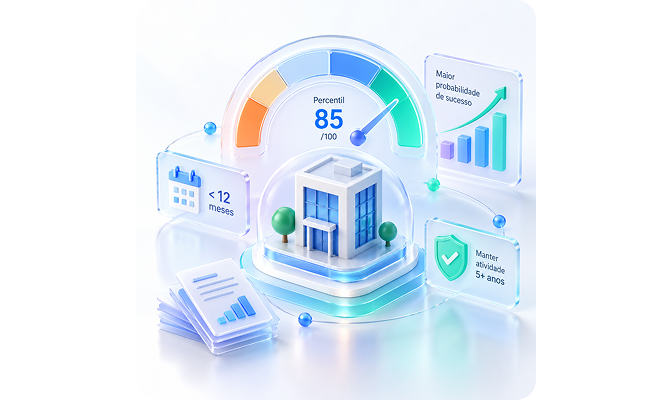
The New Business Viability Indicator reflects the probability that a company established less than 12 months ago will remain active during its first five years.
Each new company is assigned a percentile score ranging from 1 to 100. The higher the score, the greater the likelihood that the company will remain in business beyond its first five years.
Informa D&B gathers a set of unique conditions to, in partnership, add value to its customers, developing and implementing custom scoring models: